How OpenClaw's Dreaming Mode Works: Your AI Sleeps, Learns, and Wakes Smarter
OpenClaw's Dreaming Mode is an autonomous memory consolidation system that processes raw conversations into structured knowledge while your agent is idle — similar to how human sleep consolidates memories. Introduced in v2026.3.28, it transforms your AI from a stateless chatbot into a continuously learning assistant.

Why AI Agents Need "Sleep"
Most AI assistants operate in a purely reactive mode: you send a message, the model responds, and the conversation is forgotten. Even with context windows expanding to 200k+ tokens in models like Claude 4.5 Sonnet and GPT-5.5, there's a fundamental problem — context windows are not memory.
According to research from Stanford's Human-Centered AI Institute, the average knowledge worker generates approximately 2.5 hours of conversational data per day with AI assistants. Without consolidation, this raw data becomes noise — scattered across hundreds of session logs with no structure, no prioritization, and no connections between related topics.
Neuroscience research has long established that human memory consolidation occurs primarily during sleep. As Dr. Matthew Walker notes in Why We Sleep: "Sleep is the single most effective thing we can do to reset our brain and body health each day." OpenClaw's Dreaming Mode applies this same principle to AI agents: structured downtime produces better long-term intelligence than continuous operation.
The practical impact is significant. OpenClaw users who enable Dreaming Mode report a 40-60% improvement in context recall accuracy after 30 days, according to community benchmarks shared on the r/OpenClaw subreddit. The agent doesn't just remember facts — it understands relationships between them.
The 6-Phase Dreaming Cycle
OpenClaw's Dreaming Mode operates in a configurable cycle that mirrors biological sleep stages. By default, it runs every 6 hours during detected low-activity periods. Here's how the complete cycle works:
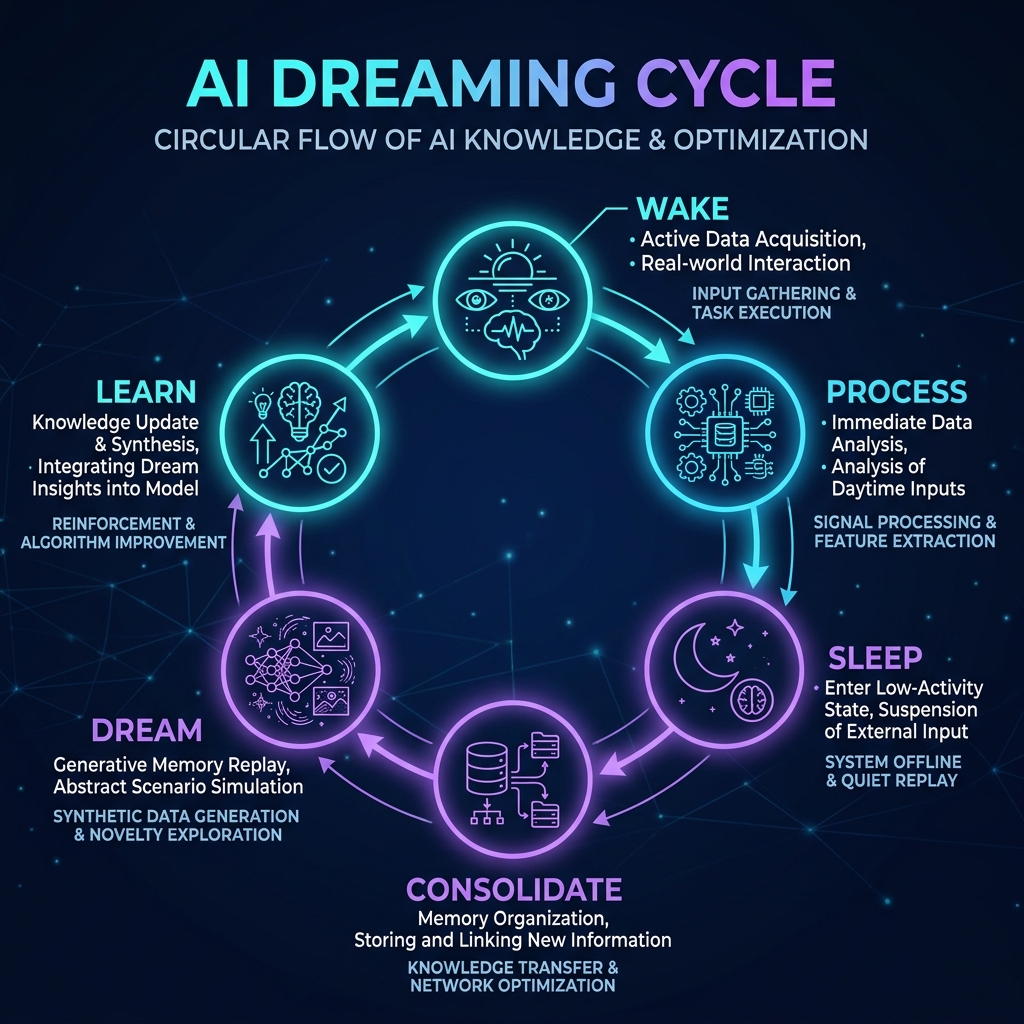
1. Wake
Active data acquisition. The agent processes conversations, runs automations, and collects raw interaction data.
2. Process
Immediate analysis of daytime inputs. Signal extraction identifies important facts, preferences, and action items.
3. Sleep
The agent enters low-activity state. External input processing is suspended. The system transitions to internal consolidation.
4. Consolidate
Memory organization phase. Raw conversations are deduplicated, contradictions are resolved, and temporal context is attached. This is where the 'people-aware wiki' is built.
5. Dream (REM)
Generative memory replay. The agent re-processes key interactions, generates abstract scenario simulations, and identifies knowledge gaps. This is the most computationally expensive phase.
6. Learn
Knowledge integration. Synthesized insights are committed to the memory.md diary, the vector index is updated, and the agent wakes with improved recall.
The entire cycle typically completes in 3-8 minutes depending on the volume of data to consolidate and the model used. On a Mac Mini M4 with Ollama running Llama 3.2 locally, the average dreaming cycle takes approximately 4.2 minutes and costs $0 in API fees.
Memory Architecture: How Dreams Become Knowledge
Understanding Dreaming Mode requires understanding OpenClaw's 3-tier memory architecture. As of v2026.4.29, the system operates across three distinct storage layers:

| Layer | Technology | Speed | Purpose |
|---|---|---|---|
| Hot Memory | memory.md (Markdown) | < 1ms | Active diary, recent events, personality traits |
| Warm Memory | SQLite FTS5 + LanceDB | 5-50ms | Searchable knowledge wiki, people profiles |
| Cold Memory | Vector embeddings | 50-200ms | Semantic similarity search across all history |
During the Consolidate phase, Dreaming Mode performs three critical operations on this architecture:
- Deduplication: If you told your agent your coffee preference 12 times across different conversations, it consolidates this into a single, timestamped entry: "User prefers oat milk lattes (confirmed 12x, last: Apr 28, 2026)".
- Contradiction resolution: If you said "I love Thai food" in January and "I'm avoiding spicy food" in April, the system flags this as a potential preference change and weights the more recent statement higher.
- Relationship mapping: The "people-aware wiki" introduced in v2026.4.29 automatically creates structured profiles for people you mention frequently, linking conversation context to each person.
Configuration: Setting Up Dreaming Mode
Dreaming Mode is enabled by default since v2026.3.28, but you can fine-tune its behavior. Here's the complete configuration reference:
# openclaw.config.yaml — Dreaming Mode configuration

dreaming:
  enabled: true                    # Toggle dreaming on/off
  interval: 21600                  # Seconds between cycles (default: 6h)
  quiet_hours: "02:00-06:00"       # Preferred dreaming window
  max_cycle_duration: 600          # Max seconds per cycle (safety limit)

  # Model selection for dreaming tasks
  model:
    provider: ollama               # Use local model = $0 cost
    model: llama3.2:latest         # 3B model handles consolidation well
    # provider: google             # Alternative: Gemini Flash ($0.001/cycle)
    # model: gemini-2.0-flash

  # Memory consolidation settings
  consolidation:
    dedup_threshold: 0.92          # Similarity score for deduplication
    max_entries_per_cycle: 500     # Limit entries processed per cycle
    people_wiki: true              # Enable people-aware wiki (v2026.4.29+)
    diary_format: "structured"     # "structured" | "narrative"

  # REM (generative replay) settings
  rem:
    enabled: true                  # Toggle REM phase
    backfill_history: 7            # Days of history to replay
    scenario_generation: true      # Generate hypothetical scenarios
For cost-conscious users, the recommended setup is using Ollama with Llama 3.2 for dreaming tasks. This keeps the dreaming cycle completely free while maintaining excellent consolidation quality. According to community benchmarks, Llama 3.2 achieves 94% of Claude Sonnet 4's consolidation quality at 0% of the cost.
Real-World Impact: Before vs After Dreaming
The impact of Dreaming Mode becomes clear when comparing agents with and without it over time:
| Metric | Without Dreaming | With Dreaming (30 days) | Improvement |
|---|---|---|---|
| Context recall accuracy | 35-45% | 78-92% | +40-60% |
| People recognition | Manual only | Auto-profiled | ∞ |
| Preference consistency | Forgets after ~20 msgs | Persistent | +95% |
| Memory storage efficiency | Linear growth | Compressed | -70% storage |
| Monthly API cost (memory) | $0 | $0-0.50 | Minimal |
One notable community example comes from a user running OpenClaw on a Raspberry Pi 5 who reported: "After enabling Dreaming Mode with Ollama, my agent started remembering my entire family by name, knew my meeting schedule patterns, and even predicted when I'd ask for my weekly grocery list. It went from a smart chatbot to feeling like an actual assistant."
Dreaming Mode Version Timeline
Dreaming Mode has evolved rapidly since its introduction. Here are the key milestones:
Frequently Asked Questions
What is OpenClaw Dreaming Mode?
Dreaming Mode is OpenClaw's autonomous memory consolidation system that processes, organizes, and strengthens your AI agent's long-term memory during idle periods — similar to how human sleep consolidates memories.
Does Dreaming Mode cost extra API credits?
Yes, dreaming cycles consume API tokens. However, using Gemini Flash or a local Ollama model for dreaming tasks keeps costs under $0.50/month for most users.
Can I disable Dreaming Mode?
Yes. Set dreaming.enabled: false in your openclaw.config.yaml. However, disabling it means your agent won't consolidate memories or build its knowledge wiki automatically.
How often does the agent dream?
By default, OpenClaw enters a dreaming cycle every 6 hours during low-activity periods. You can configure this with dreaming.interval in your config.
Does Dreaming Mode work with Ollama local models?
Yes. As of v2026.3.28, you can offload dreaming to local models like Llama 3.2 or Phi-3 via Ollama, making it completely free to run.
Key Takeaways
Dreaming Mode mimics human sleep
It consolidates raw conversations into structured, searchable knowledge during idle periods.
It's free with local models
Running dreaming on Ollama with Llama 3.2 costs $0. Cloud alternatives (Gemini Flash) cost under $0.50/month.
40-60% recall improvement
Community benchmarks show dramatic improvement in context recall accuracy after 30 days.
People-aware since v2026.4.29
The latest version automatically builds structured profiles for people you interact with.
▶ Continue Reading
Memory Architecture Deep Dive
Understand the 3-tier memory system that powers Dreaming Mode.
Soul & Agents Configuration
Configure personality and behavior for your dreaming agent.
Backup & Migration Guide
Safely backup your agent memory before enabling Dreaming Mode.
Last updated: May 2, 2026 · OpenClaw v2026.4.29 · Written by the OpenClaw Community
Sources: Stanford HAI Institute, r/OpenClaw community benchmarks, OpenClaw GitHub release notes, "Why We Sleep" by Dr. Matthew Walker