Frequently Asked Questions
Q1. Is AutoGPT still actively maintained in 2026?
Q2. Can OpenClaw do everything AutoGPT can?
Q3. Does OpenClaw support custom tools?
Q4. Which is better for beginners?
OpenClaw vs AutoGPT: The Reality of Autonomous Agents in 2026
Remember when AutoGPT broke the internet in 2023? Three years later, we look at why the hype died down and how OpenClaw solved the dreaded "Infinite Loop" problem.
In mid-2023, AutoGPT captured the world's imagination. You gave it a goal—like "Increase my Twitter following"—and it would spin up browsers, search the web, and run code autonomously. It felt like artificial general intelligence (AGI) had arrived early.
But then reality hit. People quickly realized that after 5 minutes of execution, AutoGPT would inevitably get stuck in an endless loop, hallucinate a Python package that didn't exist, and rack up a $50 OpenAI API bill doing absolutely nothing useful.
The Infinite Loop Problem
The fatal flaw of early autonomous agents like AutoGPT and BabyAGI was their lack of state boundaries and verified environment feedback. They basically hallucinated a terminal environment and assumed every action succeeded without robust error handling.
AutoGPT Execution
- Goal: "Order a pizza"
- Loop 1: Searches Google for pizza.
- Loop 2: Writes a python script to scrape Domino's.
- Loop 3: Script fails due to Cloudflare.
- Loop 4: Agent writes a new script to bypass Cloudflare. (Fails).
- Loop 5: Keeps trying to bypass Cloudflare until credit card is declined.
OpenClaw Execution
- Goal: "Order a pizza"
- Action 1: Checks pre-approved "Skills" library.
- Action 2: Uses verified `ubereats-api` skill.
- Action 3: Hits a 2FA prompt.
- Action 4: Pauses execution and asks human via Telegram for the OTP.
- Action 5: Order succeeds. Task terminated.
Built for Production vs Built for Demos
AutoGPT is a researcher's sandbox. It is fundamentally unstructured. It is amazing for pushing the boundaries of what an LLM can theoretically figure out in a blank terminal, but you cannot trust it to manage your production database or handle customer support emails.
OpenClaw is an operating system. It introduces massive constraint architecture. Instead of letting the LLM do whatever it wants, OpenClaw provides:
- Strict Skill Boundaries: The agent can only execute tools explicitly registered in its skills.yaml. It cannot arbitrarily run system commands unless granted the bash skill.
- Human-in-the-Loop Routing: If OpenClaw exceeds its confidence threshold (e.g., executing a DROP TABLE command), it pauses and pings the administrator for approval.
- Local LLM Sub-routing: Instead of sending every thought to GPT-4, OpenClaw uses local models (like Llama-3-8B) for routing and syntax checking, saving money and reducing latency.
Conclusion
If you want to watch an AI creatively try (and likely fail) to build an entire SaaS company from scratch in a terminal, run AutoGPT. It's wildly entertaining.
If you want a dependable, self-hosted worker that can read your GitHub PRs, query your PostgreSQL database, and notify you on Slack—without randomly trying to scrape the entire internet—OpenClaw is the enterprise-ready evolution of the agent concept.
Execution Flow: Side by Side
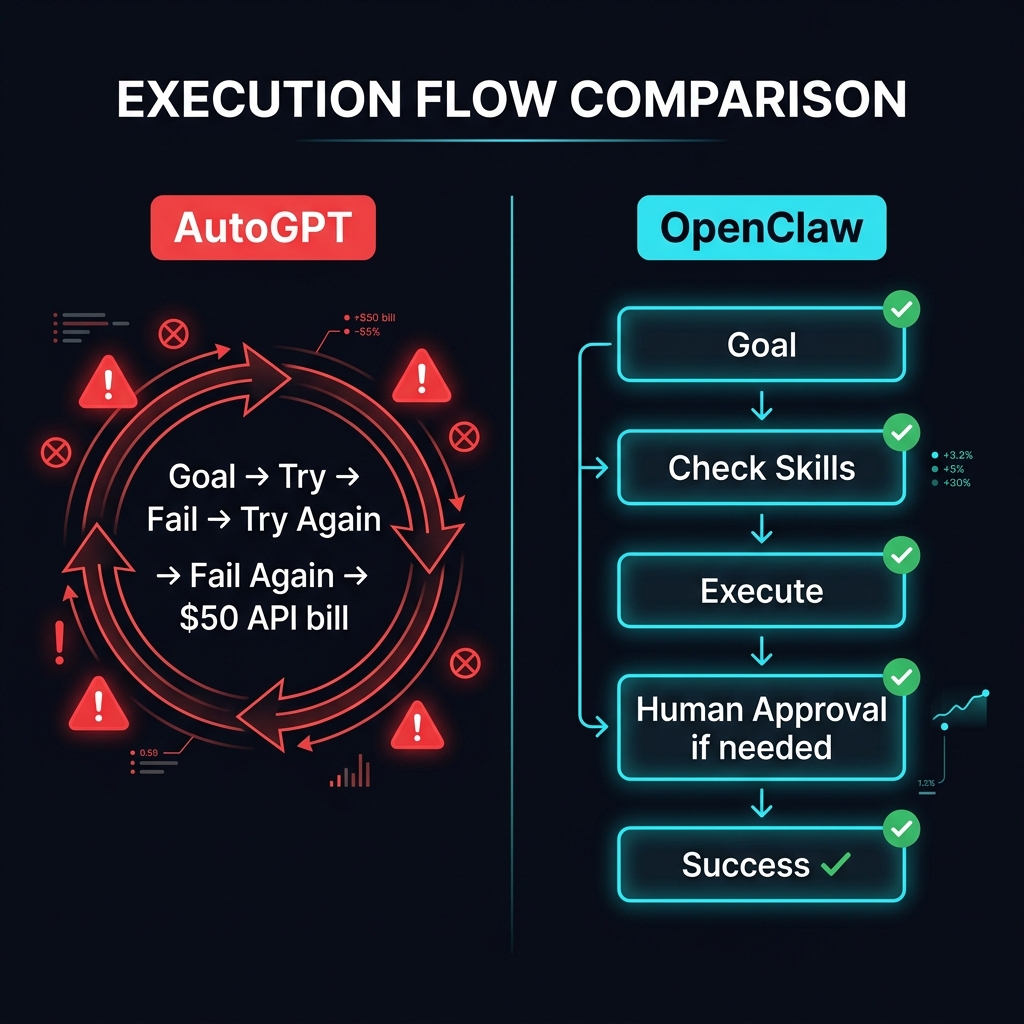
The diagram below visualizes why AutoGPT loops while OpenClaw converges. The key difference is that OpenClaw routes every action through a pre-validated skill registry and checks for deterministic exit conditions before proceeding.
Memory Systems: Goldfish vs Elephant
AutoGPT's memory is session-scoped. Each run starts fresh with a context window. This means it can't learn from past failures or maintain long-term state across tasks.
OpenClaw uses a layered memory architecture: short-term (in-context), medium-term (vector store), and long-term (SQLite files). It genuinely remembers that you prefer bullet-point answers, that your server is 'prod-1', and that you don't want it touching the payments table without explicit approval.
Real-World Cost Comparison
| Scenario | AutoGPT | OpenClaw |
|---|---|---|
| 100 simple tasks/month | ~$4.50 | ~$0.00 |
| 500 research tasks | ~$28.00 | ~$1.80 |
| Agentic loop (1 hour) | ~$12-50 | ~$0.10 |
OpenClaw routes to local Ollama for 90% of tasks. AutoGPT defaults to GPT-4 for every reasoning step.