Frequently Asked Questions
Q1. Can n8n and OpenClaw work together?
Q2. Does OpenClaw have a visual interface like n8n?
Q3. Which tool has better community support?
Q4. Is OpenClaw suitable for enterprise use?
OpenClaw vs n8n: Which Self-Hosted Automation Tool Wins in 2026?
Node-based workflows or autonomous agents? We break down the ultimate battle for your personal server.
If you are building a self-hosted automation stack in 2026, you are likely looking at two major players: n8n and OpenClaw. While both tools allow you to connect APIs and run tasks locally, their underlying philosophies couldn't be more different.
n8n is the undisputed king of visual, node-based automation. If you need rigid, predictable data pipelines, it's a masterpiece. OpenClaw, on the other hand, is born from the LLM era. It's an autonomous, agentic framework designed to handle fuzzy logic, natural language, and autonomous decision-making.
The Core Difference: Workflows vs Agents
n8n Paradigm
Deterministic Pipelines.
- 100% predictable execution path
- Complex visual node editing
- Breaks easily if API response format changes
OpenClaw Paradigm
Goal-Oriented Autonomy.
- High adaptability to unstructured data
- Natural language instruction (YAML)
- Slightly slower execution due to LLM overhead
Round 1: Setup & Integrations
n8n boasts over 1,000+ native integrations. If you are using enterprise software, n8n likely has a bespoke node for it. The setup is straightforward via Docker, but mastering the UI takes weeks.
OpenClaw takes a different approach. Instead of hardcoded nodes, OpenClaw relies on "Skills" (YAML + Python) and its ability to read raw API docs. You can literally prompt OpenClaw: "Read the Stripe API docs and refund invoice #1234". For standard integrations, OpenClaw has about 200+ community skills, but its real power is zero-shot API integration.
Round 2: Handling the Unexpected
Goal: Manage this customer request resolving it based on the CRM.
Verdict: Which should you choose?
Choose n8n if:
- You need millisecond latency for webhooks.
- You are moving highly structured data between databases with zero variance.
- You prefer drawing visual flowcharts to structure your logic.
Choose OpenClaw if:
- You are dealing with human language (support tickets, summarization, research).
- You want to build a "Personal Assistant" you can chat with over Telegram/Discord.
- You find maintaining complex 100-node n8n workflows exhausting.
The reality? The best setups in 2026 use both. Power users let n8n handle rigid cron-jobs and heavy data ETL, while passing fuzzy, logic-heavy tasks to their self-hosted OpenClaw node for cognitive processing.
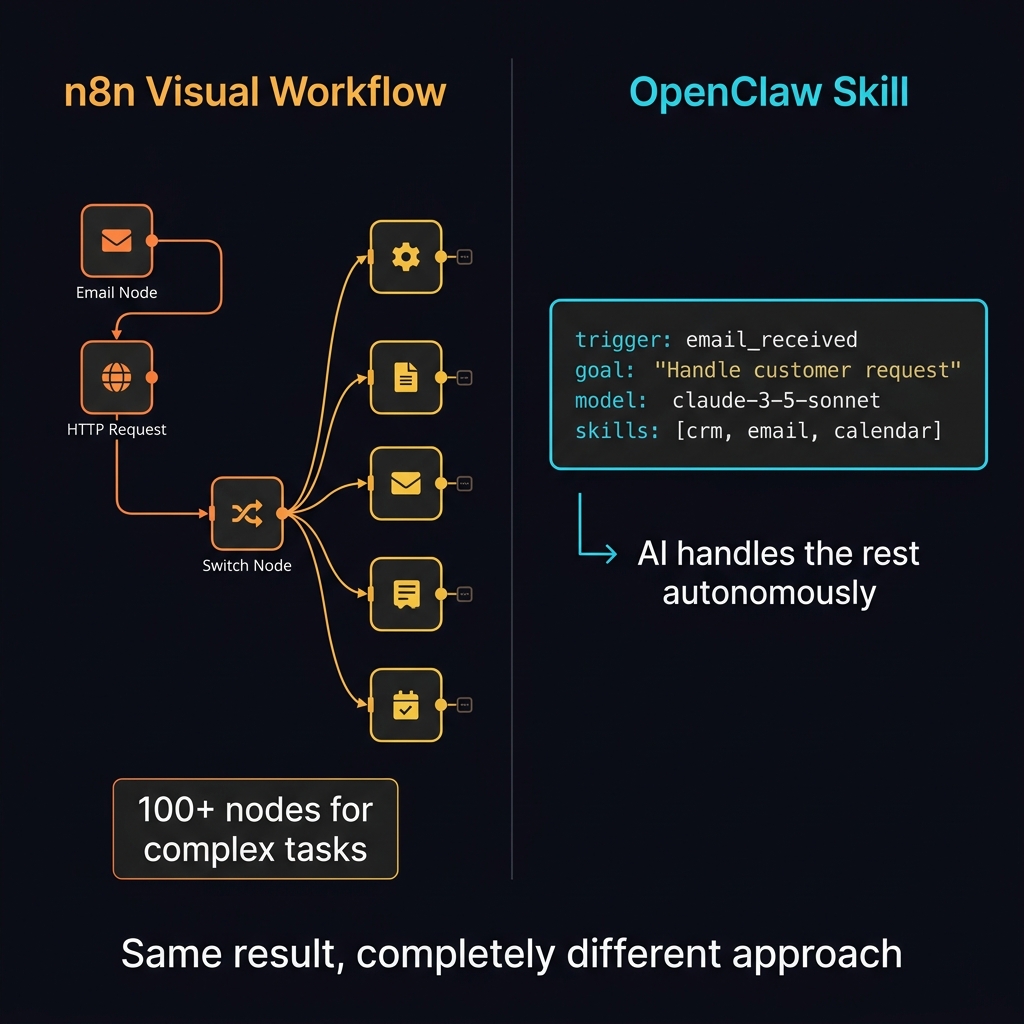
The Architecture Difference Visualized
The diagram below illustrates the fundamental paradigm shift. n8n requires you to define every possible branch and edge case as a visual node. OpenClaw requires you to define the goal and trust the AI to determine the execution path.
Performance Benchmarks
In practice, neither tool is universally faster. Performance depends entirely on the task type:
| Task | n8n | OpenClaw |
|---|---|---|
| Structured data ETL (CSV → DB) | ⚡ Wins — <100ms | Slower (LLM parsing overhead) |
| Email classification + CRM update | Requires 8+ nodes | ⚡ Wins — 1 YAML goal |
| Research + summarize 50 docs | Not feasible | ⚡ Wins — native reasoning |
| Webhooks with millisecond SLA | ⚡ Wins | ~300ms LLM overhead |
| Multi-step customer support | Complex branching required | ⚡ Wins — conversational |