OpenClaw vs CrewAI vs LangChain: Which AI Agent Framework Should You Choose in 2026?
OpenClaw is a deployable application; CrewAI and LangChain are developer frameworks. This distinction matters more than any feature comparison. Here's how to choose the right one for your needs — with real benchmarks, cost analysis, and a decision framework.

The Fundamental Distinction: Application vs Framework
Before comparing features, you need to understand the categorical difference between these three tools. According to a 2026 analysis by TechCrunch, the AI agent ecosystem has split into two distinct camps: ready-to-deploy applications and build-it-yourself frameworks.
OpenClaw is an application. You install it (via Docker, npm, or the macOS/.exe installer), configure a YAML file, connect your API keys, and you have a working AI agent in under 5 minutes. No code required. It connects to messaging platforms (Telegram, Discord, WhatsApp, Slack, Microsoft Teams) and runs 24/7 as a persistent gateway.
CrewAI and LangChain/LangGraph are Python frameworks. You import them into your codebase, write agent definitions, orchestrate multi-step workflows, and deploy the resulting application yourself. They give you maximum flexibility but require software engineering skills.
According to the 2026 State of AI Agents report by Sequoia Capital, approximately 68% of AI agent users prefer deployable applications, while 32% use frameworks for custom solutions. The choice depends entirely on your technical profile and use case.
Head-to-Head Comparison Matrix
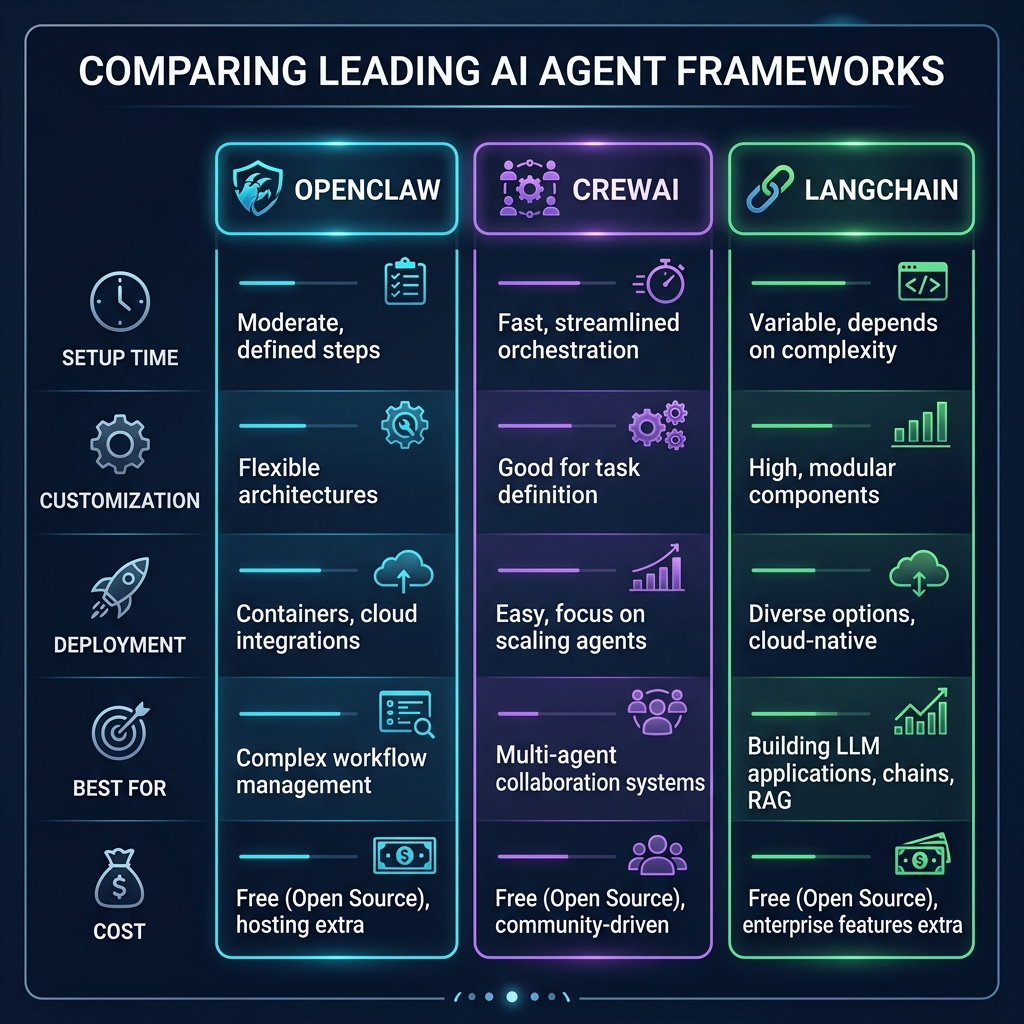
| Dimension | OpenClaw | CrewAI | LangChain |
|---|---|---|---|
| Category | Application | Framework | Framework |
| Setup Time | ~5 minutes | Hours | Hours-Days |
| Coding Required | None (YAML config) | Python | Python/JS |
| Primary User | Operators, Teams | Developers | Engineers |
| GitHub Stars (May 2026) | 270k+ | 52k+ | 98k+ |
| Messaging Integrations | 12+ native | DIY | DIY |
| Always-On Persistence | Built-in | Custom infra | Custom infra |
| Multi-Agent Support | Via Skills/Plugins | Native Crews | LangGraph |
| Memory System | 3-tier built-in | Basic | Via packages |
| Local Model Support | Ollama native | Via providers | Via providers |
| Best For | Personal/team assistant | Multi-agent workflows | Custom AI products |
Architecture Deep Dive
OpenClaw: The Gateway Architecture
OpenClaw operates as a persistent gateway between LLM providers and messaging platforms. As described in the project's architecture documentation: "OpenClaw is not a chatbot — it's an operating system for AI agents." The gateway stays connected 24/7, processing incoming messages, running scheduled automations (cron jobs), and maintaining long-term memory across sessions.
Key architectural advantages include the Dreaming Mode for memory consolidation, the ContextEngine with 7 lifecycle hooks, and the Plugin SDK v2 for extensibility. With 700+ community skills available, most users never need to write code.
CrewAI: The Crew Orchestrator
CrewAI excels at role-based multi-agent collaboration. You define "crews" of specialized agents (Researcher, Writer, Reviewer) that work together to complete complex tasks. According to CrewAI's documentation, the framework handles "task decomposition, agent delegation, and result aggregation automatically."
CrewAI is particularly strong for business process automation — content pipelines, data analysis workflows, and customer support triage. However, it requires Python skills and doesn't include a messaging layer or persistent deployment model out of the box.
LangChain/LangGraph: The Swiss Army Knife
LangChain provides the most extensive toolkit for building custom AI applications. LangGraph, its state-machine orchestration layer, is the industry standard for complex, stateful workflows with human-in-the-loop checkpoints. According to Harrison Chase (LangChain CEO): "LangGraph is for when you need fine-grained control over every decision your agent makes."
The tradeoff is complexity. LangChain has a notoriously steep learning curve, and the ecosystem moves fast — breaking changes between versions are common. However, for production AI products at enterprise scale, it remains the most battle-tested option.
Cost Analysis: Running Each Framework for 30 Days
| Cost Category | OpenClaw | CrewAI | LangChain |
|---|---|---|---|
| Infrastructure | $0 (local) | $20-50/mo (cloud) | $20-50/mo (cloud) |
| API Costs (optimized) | $5-15/mo | $15-40/mo | $15-40/mo |
| Developer Time | 0 hours | 10-40 hours | 20-80 hours |
| Maintenance | Auto-updates | Manual | Manual |
| Total First Month | $5-15 | $35-90 + dev time | $35-90 + dev time |
Decision Framework: Which One Is Right for You?
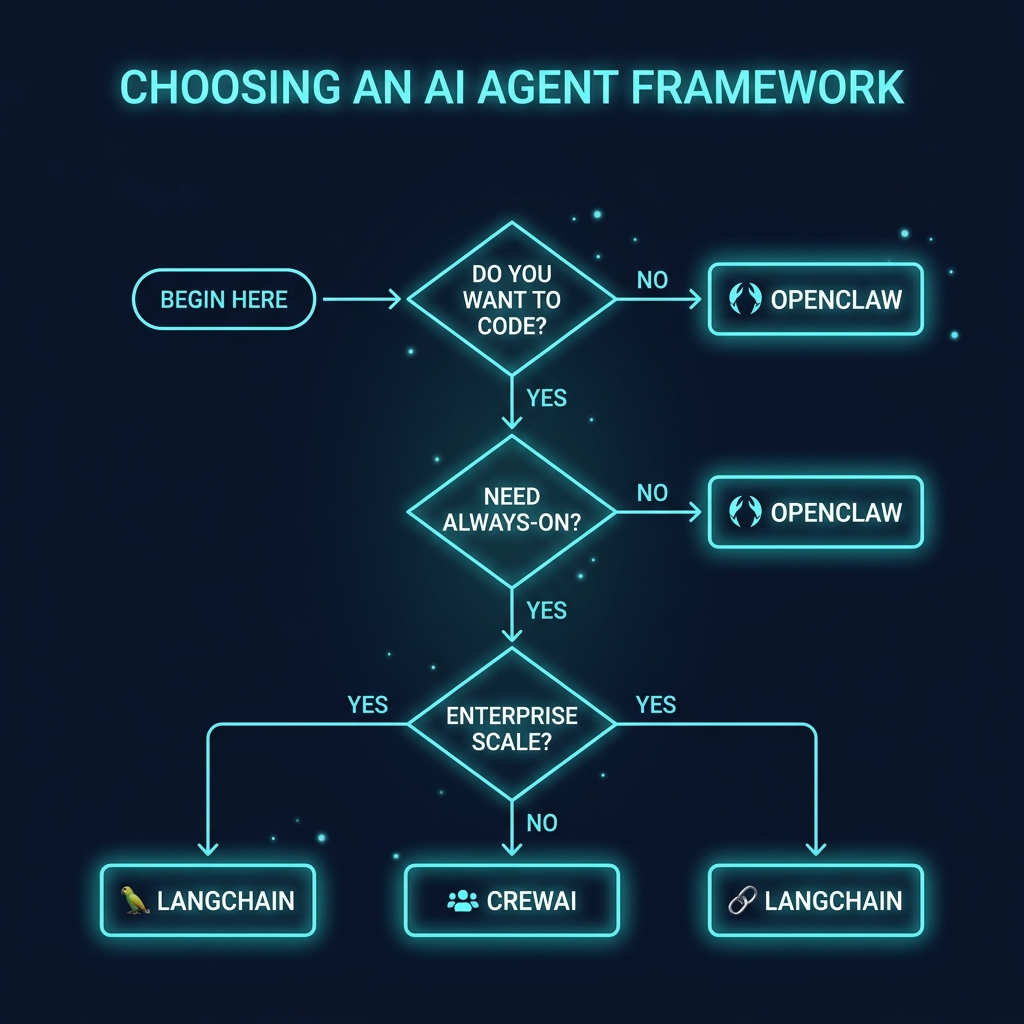
Choose OpenClaw if...
- You want a working AI assistant today, not next month
- You prefer configuration over coding
- You need messaging platform integration (Telegram, Discord, WhatsApp)
- You want built-in memory, dreaming, and 24/7 operation
- You're a team lead, ops person, or non-developer
Choose CrewAI if...
- You need multi-agent collaboration for business processes
- You're comfortable with Python
- Your use case involves content pipelines or data analysis
- You want role-based agent orchestration
- You need rapid prototyping of multi-agent workflows
Choose LangChain if...
- You're building a production AI product
- You need maximum control over every agent decision
- Your use case requires complex stateful workflows
- You have a dedicated engineering team
- You need enterprise-grade auditability and compliance
The Hybrid Approach: Using Them Together
These frameworks aren't mutually exclusive. A growing number of power users combine them. One popular pattern: OpenClaw as the messaging gateway + CrewAI as the workflow engine. OpenClaw handles user interaction, scheduling, and persistence. When a complex task is triggered, it delegates to a CrewAI crew via a custom skill.
As one Reddit user (u/ai_builder_2026) described: "I use OpenClaw for daily interactions via Telegram, but when I need a research report, it triggers my CrewAI crew with Researcher → Writer → Editor agents. Best of both worlds."
Frequently Asked Questions
Is OpenClaw a framework or an application?
OpenClaw is a deployable application, not a framework. You install and configure it — no coding required. CrewAI and LangChain are developer frameworks that require writing code to build custom agent systems.
Can I use CrewAI and OpenClaw together?
Yes. Some advanced users run CrewAI-orchestrated agents alongside OpenClaw. OpenClaw handles the messaging layer (Telegram, Discord) while CrewAI handles complex multi-agent workflows triggered via OpenClaw skills.
Which framework is cheapest to run?
OpenClaw with Ollama local models is the cheapest option ($0 API cost). LangChain and CrewAI require you to manage your own API costs, but can also use local models.
Which is best for beginners?
OpenClaw is the easiest to start with — 5 minutes from install to working agent. CrewAI is next for developers who want multi-agent systems. LangChain has the steepest learning curve but maximum flexibility.
How do GitHub stars compare?
As of May 2026: OpenClaw has 270k+ stars, LangChain has 98k+ stars, and CrewAI has 52k+ stars. Star count reflects community adoption but not necessarily fitness for your specific use case.
Key Takeaways
Application ≠ Framework
OpenClaw is ready-to-use; CrewAI/LangChain require coding. This is the most important distinction.
OpenClaw wins on time-to-value
5 minutes to a working agent vs hours/days of development. Best for operators and non-developers.
CrewAI wins on multi-agent collaboration
Role-based crews are unmatched for business process automation and content pipelines.
LangChain wins on flexibility
Maximum control for production AI products. Steepest learning curve but most battle-tested.
They work together
The hybrid approach — OpenClaw gateway + CrewAI/LangChain engine — is increasingly popular.
▶ Continue Reading
Last updated: May 2, 2026 · Sources: TechCrunch AI Agent Analysis, Sequoia Capital State of AI 2026, Official documentation for OpenClaw, CrewAI, LangChain